SEO
Google AI Overviews: How They Affect B2B Click-Through (Real Data)
What the Google AI Overviews B2B impact actually looks like
Google AI Overviews are generative summaries Google places above organic results, and they suppress click-through rates on informational queries. For B2B sites, the impact is real but uneven. Top-of-funnel blog traffic absorbs most of the damage. Branded and transactional queries stay largely intact.
Most posts on this topic recycle two charts and one panic headline. This one starts from Google Search Console patterns we see in B2B site audits, layered onto third-party trigger-rate data, so you can separate signal from noise on your own account.
If you run marketing or SEO at a 50 to 300 person B2B company, the question is not whether AI Overviews exist. It is which of your URLs are exposed, by how much, and what to do about it without burning the rest of your stack.
This post covers four things: how AI Overviews change CTR mechanically, why B2B queries are less exposed than the headline numbers suggest, what GSC actually shows when AIOs roll out on your keywords, and your real options for opting out (which are worse than vendor blog posts admit).
How AI Overviews change click-through rates
AI Overviews push the first organic result further down the page. The CTR penalty follows from that displacement, not from any change in user intent.
RAB2B estimates organic traffic losses of 10 to 30% on affected queries, with some informational pages losing 50 to 60% or more. The range is wide because trigger rate varies sharply by query type and vertical. A 2025 BrightEdge report cited by Whistler Billboards found AI Overviews now appear in over 35% of all U.S. Google desktop searches, and the share keeps climbing.
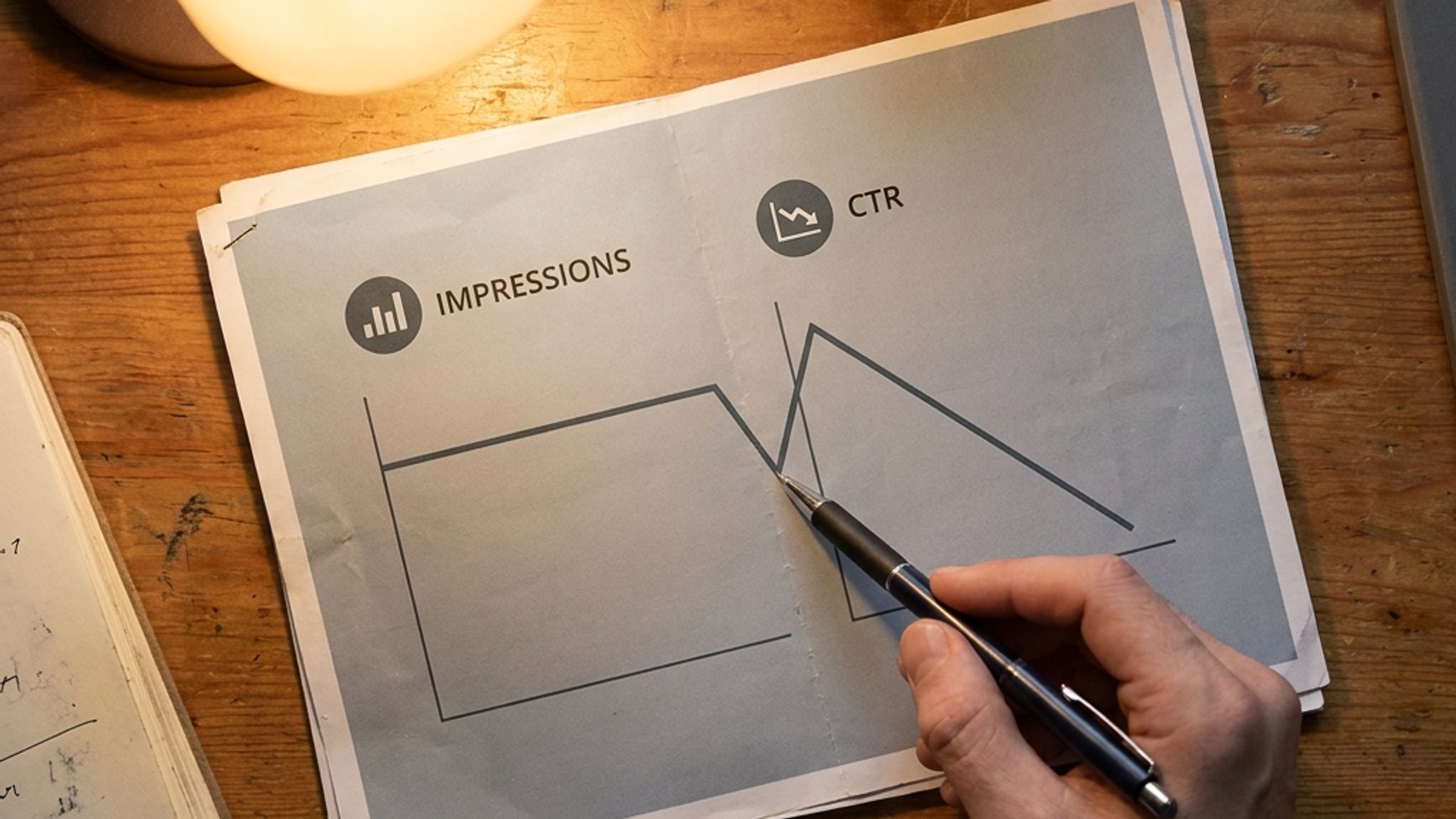
The mechanism matters. Position displacement, not intent change. Impressions can hold steady while clicks fall, which is why teams tracking only rank position miss the damage entirely.
There is a counterweight. Branded queries trigger AI Overviews only 4.79% of the time, and when they do, CTR rises by 18.68% according to Search Engine Land's data. That asymmetry is the cleanest argument for investing in brand search alongside generic SEO, and most B2B companies underweight it.
AI Overview trigger rate by query type
Query type | AI Overview trigger rate |
|---|---|
Healthcare queries | 76% |
All US desktop searches | 35% |
Finance queries | 17% |
Branded queries | 4.79% |
Why B2B queries are less exposed than most reports suggest
B2B sits closer to finance than to healthcare on the trigger curve. A study of 1 billion queries found 76% of healthcare searches triggered an AI Overview, compared to 17% in finance. Most B2B SaaS queries fall in or below the finance range, because they imply evaluation rather than a single answerable fact.
Three reasons B2B holds up better than the headline numbers suggest:
Commercial intent resists summarization. "Best identity provider for SOC 2 evidence collection" is a vendor comparison, not a fact lookup, and Google's AIO model is reluctant to recommend specific products by name.
Long-tail specificity dilutes the answer. "Enterprise SSO integration for Salesforce sandbox environments" is harder to summarize generically than "what is single sign-on."
Decision-stage searchers click through anyway. They want pricing, docs, security questionnaires, integration guides. A summary does not replace any of those.
The post that gets hit hardest is your "what is X" awareness piece. The post that holds is your comparison page, your integration doc, your case study. If you run AEO and GEO work without segmenting your URL inventory by intent first, you will optimize the wrong pages.
The implication is unglamorous. Audit your exposure before building a mitigation strategy. Most B2B sites are not uniformly affected, and pretending otherwise wastes the budget you should be spending on the 5 to 10 URLs that actually bleed.
What GSC data shows in B2B accounts
In B2B audits, one pattern repeats. Impression counts hold or rise after AI Overviews roll out on a keyword cluster. CTR drops. Rankings look stable on paper, but clicks do not follow.
That impression-to-CTR divergence is the signal most teams miss, because they track average position, not CTR-per-impression by query cluster.
Here is the GSC method that surfaces it:
In Search Console, open the Performance report and pick a 90-day window.
Filter by page, then export the query list with impressions, clicks, CTR, and average position.
Compare the same window against the prior 90 days, query by query.
Flag queries where impressions held within 10% but CTR fell more than 30%. Those are your AIO-exposed terms.
Group flagged queries by URL. The URLs with three or more flagged queries become your priority list.
Run this once a quarter. The first time you do it on a B2B blog, expect the awareness pages to dominate the flagged list, while feature pages and branded queries look untouched. That distribution is your map.
PAN Communications maintains a public B2B AI Overview Tracker that benchmarks AIO exposure across B2B query clusters in real time. Cross-reference it against your own flagged list. If your industry's tracker numbers are climbing but your GSC shows nothing, you are either ranking outside the AIO citation set or your tracking window is too short.
This GSC-first method beats third-party traffic estimates every time, because it isolates your actual query set, not an industry average that may not apply to your URL inventory.
Your real options for opting out (and why most are bad)
Three opt-out mechanisms exist for publishers, and all of them carry trade-offs that vendor blog posts gloss over.
The nosnippet meta tag tells Google not to show a text snippet from your page, which also removes you from AI Overviews. It also kills your featured snippets, your meta descriptions in some SERPs, and most rich results. You lose far more than you gain.
The max-snippet:0 directive does the same thing with a slightly different syntax. Same trade-off.
The Google-Extended user agent block in robots.txt stops Gemini and Vertex AI from training on your content, but does not remove you from AI Overviews, because AIOs use a separate retrieval pipeline. This is the most commonly misunderstood control on the list.
If you do nothing, you stay eligible for citation. RAB2B notes that top-ranked sources cited in AI results have seen up to a 219% increase in clicks when their content gets pulled into the summary. Citation-and-click is the upside scenario, and you forfeit it the moment you opt out.
Our position: do not opt out. Restructure your at-risk pages so they are the source AIOs cite, not the ones AIOs replace. That is what getting cited by ChatGPT and Google actually requires, and the playbook overlaps almost entirely with traditional E-E-A-T work.
Frequently Asked Questions
Do AI Overviews hurt B2B traffic?
They hurt informational, top-of-funnel traffic. Awareness-stage blog posts ("what is X", "how does Y work") see the largest CTR drops, often 30 to 60% on affected queries per RAB2B's reporting. Branded, comparison, and feature-specific pages are mostly intact, because those queries trigger AIOs less often and the searcher still wants to click through.
How do I opt out of Google AI Overviews?
You can use nosnippet or max-snippet:0 meta tags to remove your page from AI Overviews, but both also strip you from featured snippets and most other rich results. The Google-Extended robots.txt block does not stop AIO inclusion, only Gemini training. For most B2B sites, the right answer is to stay in and compete for citation, not opt out.
What is the AI Overviews CTR impact on B2B?
It depends on query type. Search Engine Land's data shows branded queries trigger AIOs only 4.79% of the time and gain a 18.68% CTR boost when they do. Generic informational queries can lose 30 to 60% of clicks once an AIO appears above them. Run a 90-day GSC audit segmented by query intent to see your specific exposure.
How often do B2B queries trigger AI Overviews?
Less often than consumer or healthcare queries. The 1 billion query study cited by RAB2B found finance queries trigger AIOs 17% of the time versus 76% for healthcare. Most B2B SaaS queries sit in or below the finance range, especially long-tail commercial-intent terms.
What to do this week
Run the 90-day GSC divergence audit. Pull your top 50 informational URLs. Flag the queries where impressions held but CTR dropped more than 30%. That list is your real AIO problem, and it is almost always shorter than the headlines suggest.
Most B2B sites we audit have 5 to 8 informational URLs absorbing the bulk of the AIO damage, and the fix is usually rewrite-and-restructure, not opt-out. If you want to know which URLs on your site are exposed and how to recover the clicks, book a free SEO audit call. 30 minutes, query-level findings, no slide decks.