SEO
ISO 27001 vs SOC 2: Which Certification Wins More B2B Deals in EU
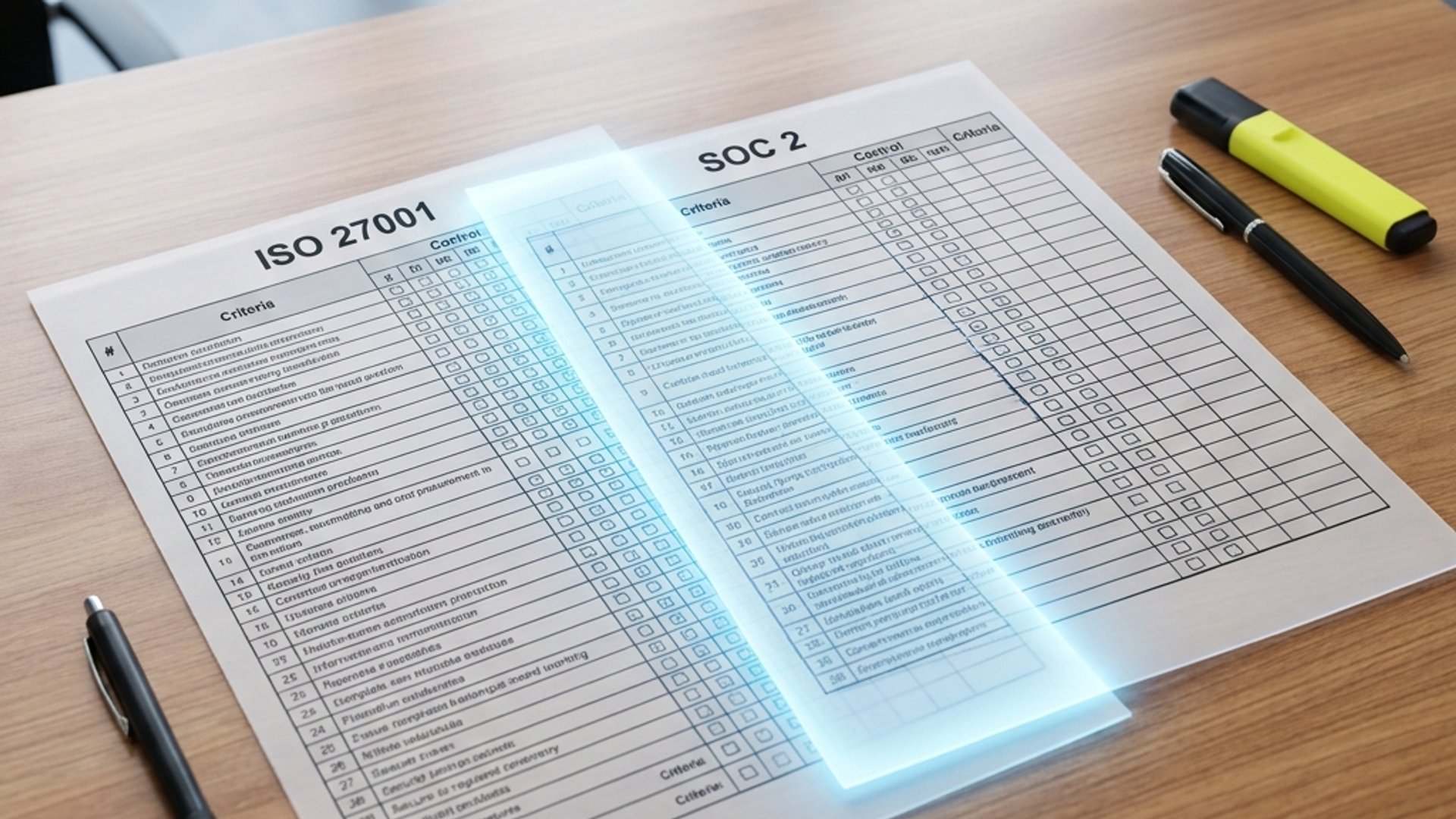
The ISO 27001 vs SOC 2 question has a geographic answer, not a technical one. ISO 27001 is a globally recognized certificate issued by an accredited third-party body, confirming you operate a working information security management system. SOC 2 is a US-origin audit report governed by the AICPA, evaluating controls against defined Trust Services Criteria. In EU B2B procurement, the two are not interchangeable, and the wrong starting point stalls deals.
Key Takeaways
EU enterprise procurement defaults to ISO 27001, which appears as a named pass/fail requirement in DACH, Nordic, Benelux, and UK security questionnaires.
ISO 27001 and SOC 2 share roughly 80% of underlying controls per Secureframe's AICPA mapping, so the second certification runs materially faster than the first.
ISO 27001 costs $10,000 to $500,000+ (Xantrion); SOC 2 Type II costs $20,000 to $85,000 (Bemo), before internal preparation hours.
DORA and NIS2 reference ISO 27001 as an accepted security baseline; neither EU regulation names SOC 2.
For mixed EU and US pipelines, ISO 27001 first then SOC 2 layered within 24 months closes more deals than the reverse order.
What do ISO 27001 and SOC 2 actually produce?
ISO 27001 issues a formal certificate, valid for three years with annual surveillance audits. SOC 2 produces an audit report from a licensed US CPA firm. EU buyers recognize the first on sight. Many have never evaluated the second.
The structural difference matters more than vendor blogs admit. ISO/IEC governs ISO 27001, and only accredited bodies (TÜV, BSI, Bureau Veritas, LRQA) can issue it. The AICPA governs SOC 2, and only US-licensed CPA firms can produce the report. ISO 27001 is pass or fail across a three-year cycle. SOC 2 Type I is a point-in-time snapshot; SOC 2 Type II observes controls across a six to twelve month window, then outputs a long-form report the reader has to interpret.
Neither is legally mandated in the EU. Both show up in enterprise security questionnaires and RFPs.
A certificate travels across markets. A report requires the reader to do work.
Which credential does EU procurement actually require?
In DACH, Nordic, Benelux, and UK enterprise procurement, ISO 27001 appears as a contractual or tender pass/fail criterion far more often than SOC 2. SOC 2 is a North American market expectation.
EU buyers in regulated sectors, financial services, automotive supply chains, and public-sector adjacent industries have built standardized questionnaires around ISO 27001 Annex A controls. German enterprise security forms list ISO 27001 as a named requirement, not a named-alternative. The DORA regulation and the NIS2 compliance landscape both reference ISO 27001 as an accepted security baseline. Neither references SOC 2.
US-founded SaaS companies expanding into DACH frequently discover their SOC 2 Type II report stalls procurement because the buyer's security team has no internal process for evaluating it. The deal does not die loudly. It just stops moving.
SOC 2 signals compliance competency to a US audience. ISO 27001 signals it to every other major market.
What does each framework actually cover?
ISO 27001 requires building and documenting an ISMS spanning 93 controls across four themes: organizational, people, physical, and technological. SOC 2 evaluates controls against up to five Trust Services Criteria, with only the Security category mandatory. The other four (Availability, Processing Integrity, Confidentiality, Privacy) are optional add-ons.
According to Secureframe's control mapping against AICPA criteria, the two frameworks share roughly 80% of underlying controls, with as little as 4% variance at the control level. That single number is the most important data point for any founder budgeting both certifications.
ISO 27001 scope can cover the whole organization or a defined boundary. SOC 2 scope is usually narrower, tied to a specific system or service. Scope flexibility cuts both ways: a narrow SOC 2 scope is cheaper to audit, but harder for EU buyers to evaluate at face value.
Dimension | ISO 27001 | SOC 2 |
|---|---|---|
Governing body | ISO/IEC | AICPA |
Output | Certificate | Audit report |
Primary geography | Global | US-dominant |
Renewal cycle | 3 years + annual surveillance | Annual (Type II) |
Controls count | 93 (Annex A) | Varies by TSC selection |
Mandatory controls | All in-scope Annex A | Security only |
How much do ISO 27001 and SOC 2 cost?
ISO 27001 certification runs from $10,000 for small companies to over $500,000 for large enterprises. SOC 2 Type II costs $20,000 to $85,000 for most B2B SaaS companies at initial audit. Both figures exclude the internal resource time and gap remediation work, which frequently exceed the audit fee itself.
Per Bemo's SOC 2 cost analysis, preparation and documentation work completed before the audit can cut SOC 2 audit costs by up to 30%. That is real money for a Series A company. It is also the line item that automation platforms like Vanta, Drata, and Secureframe target with their subscription pricing.
Certification | Cost range | Source |
|---|---|---|
ISO 27001 (small to enterprise) | $10,000–$500,000+ | |
SOC 2 Type II (initial audit) | $20,000–$85,000 | |
Pre-audit prep impact on SOC 2 fees | up to 30% reduction |
ISO 27001 takes 6 to 18 months to initial certification. SOC 2 Type II requires a minimum 6-month observation window before any report is issued, with 9 to 12 months end-to-end as the realistic baseline. The hidden cost most guides skip: policy writing, risk register creation, asset inventory, and internal training hours. For companies starting from zero, those line items consistently run higher than the audit fee.
Should you sequence both certifications?
Because ISO 27001 and SOC 2 share roughly 80% of underlying controls, building one framework first creates a documented foundation that makes the second materially faster and cheaper. The order matters.
For EU-focused companies, ISO 27001 first is the more efficient sequence. The ISMS structure, risk treatment process, and Annex A evidence already satisfy the majority of SOC 2 Security criteria. Adding SOC 2 on top is mostly an exercise in scoping, mapping, and audit scheduling, typically achievable within 12 months of initial ISO certification.
SOC 2 first is the common path for US-founded companies, and it is the more expensive path if you later need ISO 27001. You will end up building the ISMS structure, management review process, and internal audit program from scratch. That is where the cost concentration sits.
Practical sequence for EU-priority companies with a US sales motion: ISO 27001 first, then SOC 2 Type II layered within 18 to 24 months. Bringing your auditor through a real environment helps, and a clean first pentest run before either audit reduces remediation cost on both.
How to choose between ISO 27001 and SOC 2
The right starting point depends on where your buyers are, not which framework has more controls or a longer name. EU buyers default to ISO 27001. US buyers expect SOC 2. If your pipeline is split, ISO 27001 first usually delivers the larger near-term revenue impact, because EU enterprise deals stall without it.
Pick by primary market:
DACH, Nordics, Benelux, Southern EU, or UK pipeline: start with ISO 27001.
US or Canada pipeline: start with SOC 2 Type II.
UK with US-origin SaaS: ISO 27001 preferred, SOC 2 accepted as a supplement.
Enterprise EU plus mid-market US in the same pipeline: ISO 27001 within 12 months, SOC 2 layered within 24.
DORA or NIS2 in scope: ISO 27001 maps more directly to regulatory expectations than SOC 2.
If your budget is constrained and your pipeline is EU-only, ISO 27001 is the single investment that unblocks deals. SOC 2 can wait.
Frequently Asked Questions
Is ISO 27001 better than SOC 2?
For EU B2B sales, yes. ISO 27001 is universally recognized across European procurement, aligns with DORA and NIS2 expectations, and produces a formal certificate buyers can verify in seconds. SOC 2 is the stronger credential for US-focused sales cycles. "Better" is a function of your geography, not the framework's technical depth.
Do I need both ISO 27001 and SOC 2?
If you sell to EU enterprise and US mid-market simultaneously, eventually yes. The 80% control overlap between the two frameworks means you are not building two separate programs. Most companies with a mixed international pipeline complete both within 24 to 30 months of starting, with the second certification running significantly faster than the first.
Which is harder to get?
ISO 27001 is typically more demanding at the outset because it requires designing and documenting an entire ISMS, including risk assessments, asset inventories, management reviews, and internal audits. SOC 2 is more flexible in scope definition, which can make initial certification faster. That flexibility also means the output is harder for EU buyers to evaluate on a like-for-like basis.
How long does each certification take?
ISO 27001 takes 6 to 18 months to initial certification, depending on existing security maturity. SOC 2 Type II requires a 6 to 12 month observation window before the report is issued, so 9 to 12 months end-to-end is the realistic baseline. SOC 2 Type I is faster (a point-in-time snapshot) but carries less weight with serious buyers.
ISO 27001 vs SOC 2: the bottom line
EU pipeline: ISO 27001 first. US pipeline: SOC 2 first. Both markets in parallel: ISO 27001 as the anchor, SOC 2 layered on top inside 24 months. The 80% control overlap means the second certification is never as expensive or time-consuming as the first.
One angle the tool-vendor blogs do not cover: your certification status shows up in how buyers find and evaluate you. Trust pages, AI-generated vendor summaries, and security questionnaire pre-screens all pull from your public content. If you want to understand which fixes are draining your traffic and how your security posture interacts with EU B2B search, book a Free SEO Audit Call. Thirty minutes, specific findings, no slide decks.